
Platelet-Poor Plasma Preparation: A Practical Foundation for Reliable Coagulation Testing
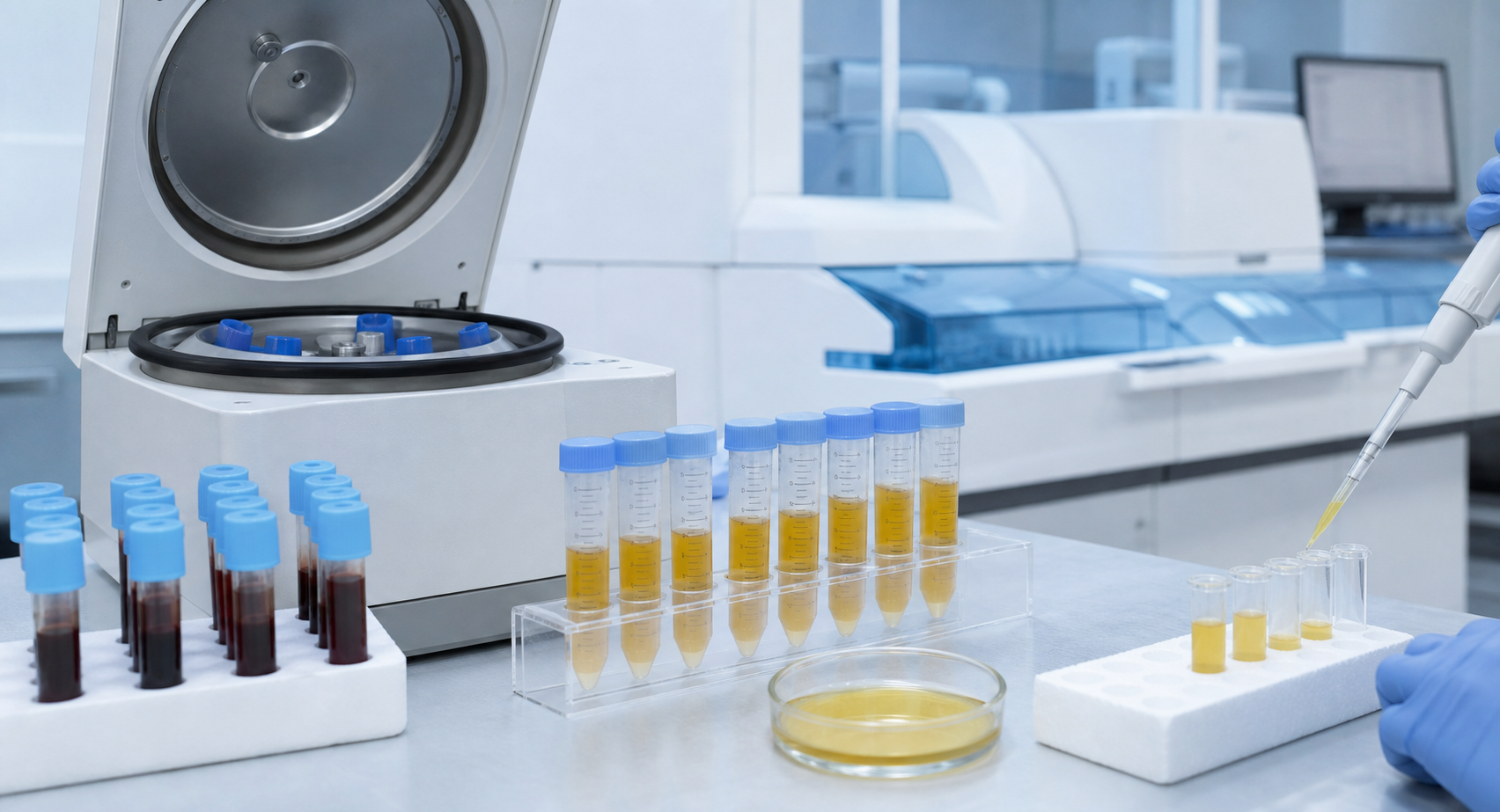
Coagulation laboratories invest heavily in reagents, analyzers, controls, and calibration, but the quality of the final result still begins with the plasma placed in the reaction cuvette. Platelet-poor plasma is often treated as a routine product of centrifugation. In practice, its preparation is a controlled pre-analytical process that can influence phospholipid-sensitive assays, special coagulation studies, sample stability, and the laboratory’s ability to investigate unexpected results.
The operational goal is straightforward: separate citrated plasma from blood cells without activating coagulation, disturbing the buffy coat, or leaving enough residual platelets to interfere with the intended test. Achieving that goal consistently requires more than selecting a centrifuge speed. Tube fill, mixing, transport, centrifugal force, time, temperature, plasma transfer, storage, and staff technique all contribute to the result.
Begin with the citrate tube, not the centrifuge
A correctly filled sodium citrate tube establishes the intended relationship between anticoagulant and plasma. Significant underfilling increases the citrate-to-plasma ratio and may prolong clot-based results. Overfilling, difficult collection, clot formation, or contamination from other tube additives can also compromise the specimen. Laboratories should define rejection criteria and train collection teams to recognize tubes that should not enter routine processing.
Immediately after collection, gentle complete mixing helps distribute citrate without creating foam or mechanical stress. The sample should then move through a controlled transport process. Long delays, unnecessary agitation, extreme temperatures, and poorly documented pneumatic-tube conditions introduce variation before the specimen reaches the centrifuge. A good plasma-preparation procedure therefore begins with collection and transport responsibilities that are clear to both phlebotomy and laboratory staff.
Use relative centrifugal force as the working parameter
Reporting centrifuge settings only in revolutions per minute is unreliable because rotor radius changes the force applied to the tube. Two centrifuges running at the same speed may produce different plasma quality. Laboratories should define and verify relative centrifugal force, processing time, brake settings, tube type, and acceptable loading pattern for each validated centrifuge.
The best setting is the one demonstrated to produce suitable plasma in the local workflow without hemolysis, cell disturbance, or unacceptable delay. A general instruction copied from another laboratory may not transfer directly when tube dimensions, rotor design, workload, or specimen volume differ. When a centrifuge is replaced or relocated, the preparation process should be reviewed rather than assumed to be equivalent.
Residual platelets matter most in sensitive workflows
For many routine PT, APTT, fibrinogen, and thrombin time measurements, a well-controlled single centrifugation may provide plasma suitable for the validated method. Special studies can be less forgiving. Residual platelets contribute phospholipid and may alter tests designed to detect phospholipid-dependent effects, particularly when plasma will be frozen and thawed. Platelet fragments released during storage can further complicate interpretation.
This is why laboratories commonly apply a more rigorous preparation process for lupus anticoagulant investigations and selected factor or inhibitor studies. Depending on the validated procedure, this may include transferring plasma to a clean secondary tube and performing a second centrifugation. The transfer must leave the lower plasma layer and buffy-coat region undisturbed. Simply repeating a spin without careful separation may not achieve the intended reduction in residual platelets.
Separate plasma without remixing the specimen
After centrifugation, rough handling can undo good preparation. Tubes should be removed without shaking, and plasma should be aspirated in a way that avoids cells near the interface. Fixed-depth aspiration, appropriate pipette tips, and sufficient residual volume above the cell layer can improve consistency. Pouring plasma between tubes is harder to control and increases the chance of cell carryover.
Visual inspection is useful but limited. Clear plasma does not prove that residual platelet concentration is acceptable, and a slightly turbid sample is not automatically unsuitable. Laboratories performing sensitive studies should periodically verify that their process meets the locally defined plasma-quality target. Verification is particularly useful after changes to centrifuges, rotors, tubes, staffing, or workload.
Control storage and freeze-thaw history
Testing time and storage conditions should match the assay and the laboratory’s validated procedure. If testing is delayed, plasma may need to be separated promptly and frozen in appropriate aliquots. Small aliquots reduce the need for repeated freeze-thaw cycles and allow the laboratory to thaw only the amount required. Containers should be compatible with frozen plasma, labeled unambiguously, and closed to limit evaporation and contamination.
Thawing should be standardized for time, temperature, and mixing. Incomplete thawing can create concentration gradients, while prolonged warming may affect labile components. Once thawed, the sample should be mixed gently and tested within the established interval. Recording freeze-thaw history is especially important when retained samples are used for repeat testing, method comparison, or investigation.
Build the procedure around real workload
A preparation method is only reliable if staff can follow it during busy periods. The written procedure should distinguish routine specimens from samples requiring enhanced preparation. It should state which centrifuge and rotor to use, how to calculate force, when a second spin is required, how much plasma may be removed, what storage conditions apply, and which deviations require recollection or supervisory review.
Simple process controls make the procedure easier to sustain. These can include centrifuge maintenance records, timer and speed checks, temperature monitoring where relevant, staff competency assessment, and periodic residual-platelet verification. A short worksheet or laboratory information system prompt can prevent special-study samples from being processed as routine specimens.
What distributors and reagent manufacturers should support
Pre-analytical guidance is part of reagent application support. A supplier should be able to explain the sample type, preparation expectations, stability limits, interference considerations, and analyzer-specific requirements associated with its assays. For OEM and localization projects, these instructions should be aligned across package inserts, training materials, application sheets, and distributor support documents.
This alignment is particularly important in developing markets, where laboratories may use several centrifuge models and where sample transport conditions vary. Practical training should help the customer translate technical requirements into an achievable local process. The supplier does not control collection or centrifugation, but clear guidance reduces avoidable troubleshooting and helps separate specimen problems from reagent or analyzer problems.
Reliable coagulation testing begins before reagent and plasma meet. When platelet-poor plasma preparation is treated as a defined, verified workflow, laboratories gain more stable routine results, more dependable special studies, and stronger evidence when investigating unexpected findings. The improvement is procedural rather than expensive: understand the sample, control the force and timing, protect the plasma during transfer and storage, and document the process well enough that every shift can reproduce it.