
From Bench Formula to Pilot Lot: Scaling Coagulation Reagent Localization
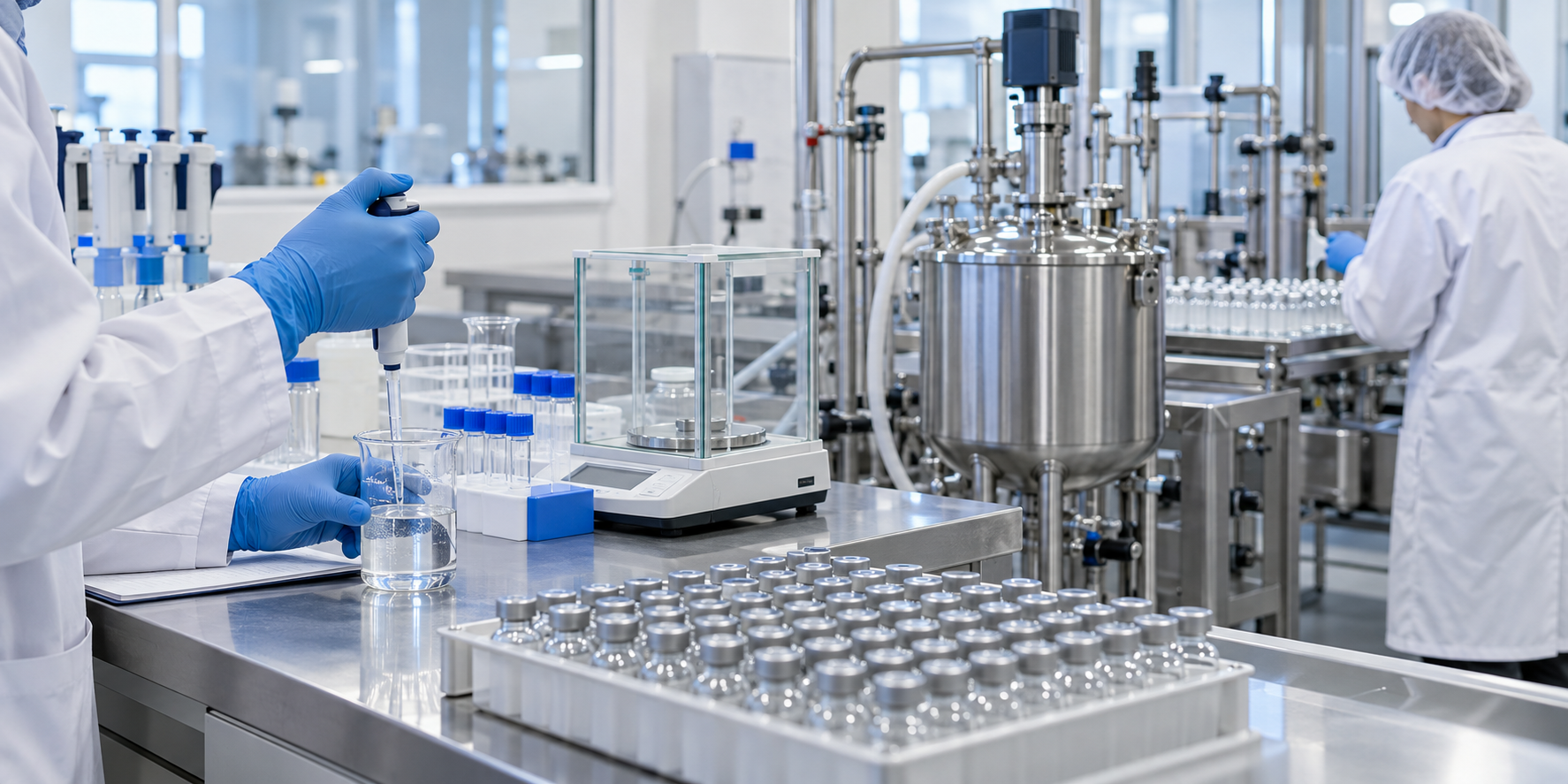
A coagulation reagent formula that performs well in a development beaker is not yet a manufacturing process. Localization requires the formulation, equipment, raw materials, mixing sequence, in-process controls, filling system, packaging, and analytical release method to work together at a larger scale. The pilot lot is where assumptions made during bench development meet the practical limits of production.
The objective is not simply to make more liquid. It is to preserve the reagent’s intended analytical behavior while creating a process that operators can repeat, quality teams can control, and distributors can support. A good pilot plan identifies which parameters are likely to change with scale and collects enough evidence to guide the first routine lots.
Freeze the development basis before scaling
Before preparing a pilot lot, the team should define the approved bench formula, raw-material specifications, target batch size, process sequence, equipment, environmental conditions, in-process tests, filling configuration, storage, and release criteria. Unresolved formulation experiments should not be mixed into a scale-up run without a clear study design.
For PT, APTT, fibrinogen, TT, D-Dimer, FDP, or antithrombin products, the critical variables differ. Biological source materials, phospholipids, activators, buffers, stabilizers, latex particles, substrates, and enzymes respond differently to mixing energy, temperature, hold time, filtration, and contact surfaces. The risk assessment should focus on the components that drive assay response and stability.
Translate ratios into a controlled sequence
A formula written as concentrations does not fully describe the process. Addition order can affect solubility, particle formation, pH adjustment, protein stability, or reagent activity. Mixing speed that is gentle in a small vessel may be inadequate in a pilot tank, while excessive shear may damage sensitive components or create foam.
The batch record should define addition sequence, mixing time, temperature window, speed or equipment setting, sampling points, pH adjustment method, and maximum hold times. Operators need observable endpoints, not instructions such as “mix until uniform” without a definition. If a concentrate is prepared before final dilution, its storage and transfer conditions also require control.
Evaluate equipment and contact materials
Scale-up introduces new surfaces: stainless steel vessels, tubing, pumps, filters, gaskets, transfer containers, and filling needles. Adsorption, extractables, residues, or cleaning agents can affect sensitive reagents. A process that worked in laboratory glass may behave differently after pump transfer or extended contact with production tubing.
Equipment qualification should confirm capacity, mixing, temperature measurement, weighing, dispensing accuracy, and cleanability. Product-contact materials should be identified and compatible with the formulation. Cleaning verification and line-clearance procedures are especially important when equipment is shared among products.
Control raw-material variability
Localization often changes the supply chain. A locally sourced buffer salt, bottle, stopper, phospholipid, latex component, or biological material may meet a general specification yet produce different assay behavior. Supplier qualification should therefore connect incoming tests to functional performance rather than relying only on identity and purity documents.
Critical materials may need small-scale qualification before the pilot lot. The team should define approved suppliers, grades, storage, retest periods, sampling plans, and substitution rules. Changing several raw materials during the same pilot makes it difficult to identify the source of a performance shift.
Design in-process controls around failure modes
In-process controls should answer whether the batch is moving toward an acceptable product. Depending on the reagent, these may include appearance, pH, conductivity, temperature, volume, mixing uniformity, particle size, activity, clotting response, absorbance background, or functional comparison with a reference batch.
Sampling location matters in larger vessels. Top, middle, and bottom samples may reveal incomplete mixing or settling. Samples collected only after transfer may miss variation in the original vessel. Acceptance ranges should be established from development evidence and refined as pilot experience grows.
Treat filling as part of the reagent system
Fill volume affects the number of tests, dead volume, onboard stability, and customer expectations. Filling accuracy and precision should be assessed across the run, including start, middle, and end. Foaming, dripping, evaporation, and line priming can create systematic differences even when the formulation is uniform.
Bottles, caps, stoppers, and labels must match analyzer use and storage claims. Container closure can influence evaporation, contamination, gas exchange, and light exposure. For lyophilized or multi-component kits, reconstitution volume and component pairing add further controls. Pilot units should use the intended commercial packaging whenever possible.
Compare analytical performance across the lot
Release testing should include the assays and result regions relevant to the product. Averages alone may hide variation across filling positions. Testing units from the beginning, middle, and end helps show whether the process remained stable. Comparison with an approved reference batch can assess bias, precision, calibration behavior, QC recovery, measuring range, and analyzer compatibility.
For clot-based reagents, normal and prolonged plasma responses may both be informative. Fibrinogen, D-Dimer, FDP, and antithrombin applications require appropriate calibration and range coverage. Pilot evaluation should use the intended analyzer application and units rather than a development setup that customers will not use.
Start stability with representative material
Bench samples stored in development containers do not fully represent pilot-filled product. Stability studies should use material produced by the intended process and placed in the intended closure. Real-time, accelerated, transport, freeze-thaw, and open-vial studies should be selected according to product risk and planned claims.
Temperature excursions during local distribution may be as important as warehouse storage. Stability plans should define test intervals, analytical methods, acceptance criteria, and sample positions. A pilot lot can support early evidence, but shelf-life claims require a controlled program and continued confirmation with routine production lots.
Use deviations as development information
A pilot lot is expected to reveal process weaknesses. Deviations should be documented with times, temperatures, quantities, equipment states, and corrective action. Quietly adjusting the process until the batch passes loses information and makes the next lot harder to reproduce.
After review, the team should update the master formula, batch record, raw-material controls, equipment settings, sampling plan, release methods, and training. Not every pilot issue requires formula redesign; many are process or documentation problems. The decision should be based on analytical evidence.
Successful localization turns a reagent concept into a controlled local capability. By treating scale, equipment, raw materials, filling, analysis, and stability as one system, manufacturers can move from a promising bench formula to pilot lots that support reliable routine production and credible distributor support.